The Digital Millennium Copyright Act (DMCA): Complete Guide
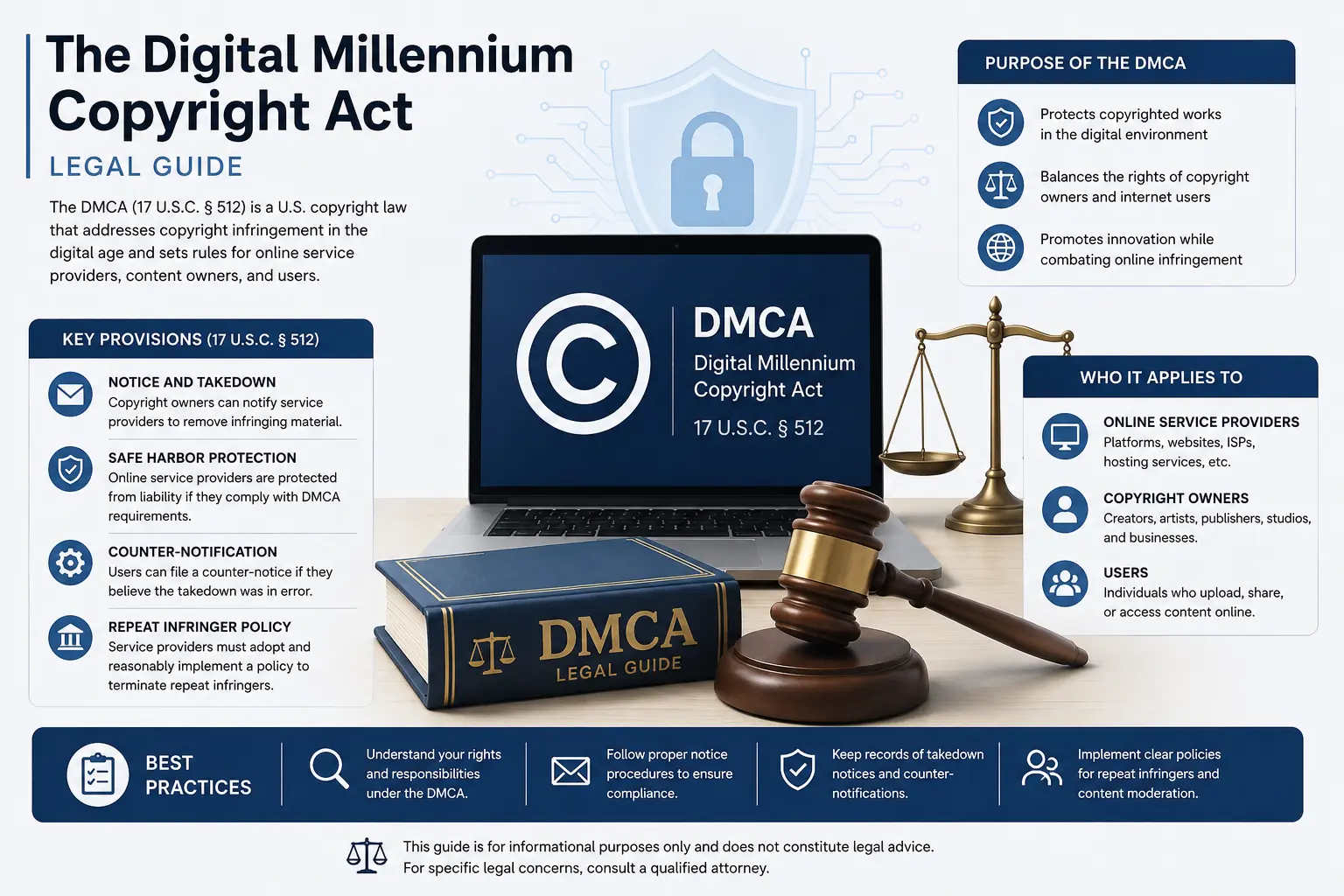
What is The Digital Millennium Copyright Act?
Definition: The Digital Millennium Copyright Act (DMCA) is a 1998 U.S. copyright law. It updates federal legal frameworks for the digital age. It balances copyright owner rights with internet platform needs. It penalizes unauthorized digital distribution while granting legal liability protection to compliant platforms.
Purpose and Background (1998)
Congress passed the DMCA in October 1998.
President Bill Clinton signed the bill into law.
The law implements two World Intellectual Property Organization (WIPO) treaties.
Before 1998, copyright law struggled with digital media.
Online platforms faced massive financial risk from user uploads.
The DMCA solved two core issues:
- It stops digital piracy and unauthorized bypass of access controls.
- It shields web hosts and search engines from blanket copyright liability.
Who Does the DMCA Protect?
The DMCA creates a legal balance between three major groups:
- Content Creators: They can quickly request removal of stolen digital work without filing lawsuits, often through specialized protection services such as DMCA Guards.
- Online Service Providers: Platforms avoid costly copyright damages if they follow removal rules.
- Digital Consumers: Users keep fair use rights for commentary, security research, and product repair.
Key Pillars of DMCA Law
Title I: Anti-Circumvention (Section 1201)
Prohibits bypassing technological locks and Digital Rights Management (DRM) protecting copyrighted works.
Title II: OCILLA / Safe Harbor (Section 512)
Establishes statutory liability limits for web platforms maintaining notice-and-takedown systems.
Title I: Anti-Circumvention Rules (Section 1201)
Section 1201 prohibits bypassing Technological Protection Measures (TPMs).
These measures include Digital Rights Management (DRM) and software access locks.
Key distinctions within Section 1201 include:
- Access Control Circumvention: Unlawfully cracking or decrypting software locks that limit content access.
- Copy Control Circumvention: Making or selling tools designed primarily to break copy protection locks.
Title II: Online Copyright Infringement Liability Limitation Act (OCILLA)
Title II limits copyright liability for qualifying online service providers.
It protects web platforms from monetary damages caused by user uploads.
Platforms must follow notice-and-takedown procedures to stay protected.
Triennial DMCA Exemptions
Congress established a review process to protect fair use.
Every three years, the Librarian of Congress grants temporary legal exemptions.
Major exemption areas include:
- Right-to-Repair: Bypassing software locks to repair vehicles, tractors, and commercial equipment.
- Accessibility: Converting digital media for visually impaired users or classroom education.
- Security Research: Testing software for security bugs and preserving old computer games.
Understanding DMCA Safe Harbor (Section 512)
What is DMCA Safe Harbor?
Safe Harbor acts as a legal defense for websites.
It protects web hosts from statutory damages up to $150,000 per work under 17 U.S.C. § 504.
Without Safe Harbor, modern social media sites could not operate.
The 4 Safe Harbor Categories
| Category | Statutory Citation | Who It Covers | Example Service Providers |
|---|---|---|---|
| Transitory Communications | 17 U.S.C. § 512(a) | Entities transmitting data without modifying content. | ISPs (Comcast, AT&T), VPNs, Wi-Fi hosts. |
| System Caching | 17 U.S.C. § 512(b) | Temporary intermediate storage of online data. | Content Delivery Networks (Cloudflare), caching systems. |
| User-Stored Material | 17 U.S.C. § 512(c) | Hosting sites where users directly upload content. | Web hosts (AWS, WordPress), social media networks. |
| Location Tools | 17 U.S.C. § 512(d) | Services linking users to third-party online locations. | Search engines (Google, Bing), link directories. |
Eligibility Requirements for Platforms
Safe Harbor protection is not automatic.
Service providers must satisfy three statutory requirements:
- No Knowledge: Providers must not know about active copyright infringement on their system.
- No Direct Financial Gain: Providers cannot profit directly from infringing activity they can control.
- Fast Removal: Providers must remove infringing content quickly after receiving a valid notice.
How to File a DMCA Takedown Notice
Prerequisites for Content Owners
Complete this checklist before submitting a takedown request:
- Verify Ownership: Confirm you own the copyright or represent the legal owner.
- Check Registration: Formal copyright registration is optional for issuing a takedown notice.
- Evaluate Fair Use: Consider whether the use qualifies as critique, commentary, or news.
Mandatory Elements of a Takedown Letter
- Signature: Include a physical or electronic signature of the copyright owner.
- Work Identification: Identify the original copyrighted work clearly with source link details.
- Infringing Location: Provide exact Web URLs where the infringing copy is hosted.
- Contact Details: Include your full name, phone number, address, and email address.
- Good Faith Statement: Declare your good-faith belief that the content use is unauthorized.
- Perjury Declaration: Confirm under penalty of perjury that your notice information is accurate.
Where to Send Takedowns
- Web Forms: Major sites like Google and YouTube offer fast online DMCA forms.
- Designated Protection Services: Automated copyright tracking solutions like dmcaguards.com streamline takedown processing and removal across stolen content sources.
- Designated Agents: Search the official U.S. Copyright Office Designated Agent Directory for smaller site agents.
What to Do If You Receive a DMCA Notice
Evaluate your legal options systematically after receiving a takedown notice.
DMCA Takedown vs. Counter-Notification Comparison
| Feature | DMCA Takedown Notice | DMCA Counter-Notification |
|---|---|---|
| Filing Party | Copyright Owner or Authorized Agent | Alleged Infringer or User |
| Primary Objective | Removes infringing content from web servers | Restores mistakenly removed web content |
| Legal Commitment | Good-faith statement under penalty of perjury | Consent to federal court jurisdiction under perjury penalty |
| Process Timeline | Immediate or expeditious platform removal | Restoration within 10 to 14 business days |
Evaluating the Claim & Fair Use
Review the taken-down content against four fair use factors:
- Is your use transformative, educational, or commercial?
- Is the original work factual or highly creative?
- Did you use a small excerpt or the full work?
- Does your content harm the creator's market value?
How to File a DMCA Counter-Notification
File a counter-notice if your content was removed by mistake.
- Draft Details: Write your legal name, contact details, and original content Web URLs.
- Jurisdiction Consent: Agree to the legal authority of the federal district court.
- Submit Notice: Send the signed document directly to the platform's DMCA agent.
The Statutory Timeline
The platform forwards your counter-notice to the original claimant.
The claimant has 10 to 14 business days to file a federal lawsuit.
If no lawsuit is filed, the platform must restore your content.
Penalties for Bad-Faith Claims (Section 512(f))
Filing false DMCA notices carries serious legal penalties.
Section 512(f) penalizes anyone who knowingly misrepresents copyright claims.
Victims can recover financial damages, court costs, and attorney fees.
DMCA Compliance Checklist for Website Owners
1. Register Designated Agent
Register with the U.S. Copyright Office directory.
Publish agent contact info in your website footer or integrate DMCA Guards protection.
2. Repeat Infringer Policy
Create and enforce a clear policy to terminate accounts of repeat copyright infringers.
3. Terms & DMCA Page
Maintain a public legal page outlining takedown rules and counter-notification steps.
Frequently Asked Questions About the DMCA
The Digital Millennium Copyright Act is a U.S. federal law.
It applies directly within United States jurisdiction.
However, over 100 countries enforce similar laws under WIPO treaties.
U.S. hosted platforms must follow DMCA rules globally.
No, copyright protection exists automatically upon work creation.
You do not need formal registration to send a DMCA takedown.
However, court lawsuits require formal copyright registration first.
The platform notifies the original copyright owner immediately.
The owner gets 10 to 14 business days to file a lawsuit.
If no lawsuit is filed, the content is restored.
Bypassing website scrap locks may violate Section 1201 anti-circumvention rules.
Courts are currently deciding if training AI on scraped data constitutes fair use.